-
News & Updates
Math
August 13, 2023
Math Fun
Have Your Fun, and Learn From It Too! — Why Games Can Make for a GREAT Option to Optimize Math Review
Let’s Have Some FUN
To sharpen learning retention in kids, it’s highly advantageous to have their full attention. And it’s even more advantageous to express the learning review in a way that’s digestible yet productive.
This is especially applicable and prevalent in math education, a discipline that requires a lot of practice and logistical awareness for the functionality of the techniques being taught. And hey, that can be unrealistic when you’re constantly lecturing them. Talking AT the students about math, or whatever they’re learning, doesn’t fully communicate the knowledge they need in order to understand what they’re being told. And even when you work one-on-one, instilling a two way path of communication about math, it may feel like pulling teeth with some kids. Admittedly, it isn’t the most enthralling of subjects for some young minds, and their resistance shows.
Another concern regarding communicable math review is the style in which you provide it. When addressing a class collectively, you’re catering to all kinds of learning styles. This can mean you have a cultivation of visual, auditory, kinesthetic, and even audio-visual learners. And although they each have individualized methods of retaining information, it is your job as an educator (or guardian) to mold a comprehensive yet constructive way to deliver the knowledge you need to.
Imagine being able to provide your students a tool, modality, or resource that not only TEACHES them the math they need, but grabs their attention in a positive and engaging way. Wouldn’t that be just AWESOME?
What’s the solution, you ask? Certainly NOT dumping a heavy review on them with no direction or energetic buffer. Instead, a better approach may be to keep it lighter in deliverance!
It’s become increasingly popular to include more lighthearted, enjoyable math reviews in the classroom through games. Yep, that’s right- games! Board games, computer games, CARD GAMES… that enjoyable pastime we highly encourage kids to participate in. And because it receives a moderately positive response from kids, it’s a prime candidate for utilization in school!
Why are they so beneficial you ask? Well, the primary appeal of games is that they’re designed to be lightly competitive but enjoyable. Not only that, they’re also easy to grasp once you play a few times (at least kid-friendly games are). If you were to find a way to incorporate math into a widely-known game structure, you create a refreshing review that actually gets the students excited to try it!
And what students love most about games is the childlike creativity or fun! If you bring a recognizable character, storyline, even movie into your classroom and use it to communicate your teaching, the students may grasp it more attentively! They naturally gravitate towards things they find enjoyable.
What games are best to use in a classroom? Well, that’s entirely situational.
If you have a smaller class size, you can split the class evenly and do multiple rounds of a one-on-one style game. For the larger-sized classes, team games are always a great way to instill community, teamwork, accountability, and enthusiasm! Students always receive teams well because they don’t want to feel isolated in their learning, and a few minds are always better than just one.
Ask yourself about these important factors when creating math review games:
Is this a game that is familiar to my students, or at least digestible in terms of difficulty?
If I give them the clear-cut directions and allow a few practice rounds, will they be able to effectively retain the knowledge while participating in the game?
Does this game have any offensive, discriminatory, or inappopriate content originally included that I can take out for my purposes?
Does this game ensure I can implement the exact math I’m teaching relatively easily?
What are some clear cut boundaries I need to set with my students?
After careful consideration, outline a game that you believe will deliver what you’re aiming to.
And if you’re looking for some guidance, look no further…
Games for Inspiration
Trivia/Jeopardy: Split the class into a few medium sized teams and create trivia style questions about math. You can give them whiteboards or paper to work out the problem on the screen, all the while collaborating with their classmates. Whoever has the correct answer first wins whatever reward was assigned to the question! This also broadens their knowledge of the discipline overall. A popular electronic trivia game is Kahoot!
What’s Missing: Memory is such an integral skill in math, and it should be exercised to the best of its ability! Present an equation, or visual representation of a problem (this is a great game for geometry-based questions) and ask the students what step or factor is missing! This helps them increase awareness for problem solving as well as formula-based questions.
True or False: Present a math equation or world problem (bonus if it’s on your assessments) and give the students an answer. It’s up to them to work on the problem on their own and decide if the answer you originally gave them was the correct one or a false one. This is also a great opportunity to work through the problem as a class AFTER you tell them if it’s true or false; some students may get it wrong, so if you show them the mistakes or misconceptions they’ll retain it. And this also helps them create a growth mindset!
Match the Equation: Matching card games are super quick, easy, and fun! You can create a deck that splits into: problems vs. answers, formulas vs. what they’re meant for, shapes vs. dimensions (size, shape, sides, etc). This is a flexible game style that’s suitable for all ages!
July 30, 2023
A Universe of Numbers
How Math Greatly Affects our Daily Life and Development of Civilization
Math has worked WONDERS for our daily lives. You may not personally enjoy the subject yourself, and that’s okay! However, it’s difficult to disregard just how influential math has become in modern society, and the development of civilization as a whole.
It’s deeply ingrained in everything we’ve built, negotiated, engineered, and modernized. It provides order in our lives and minimizes the chaos. Our statistics, logic, ethics, and deeply encoded practices all have math to thank. And whether we see it or not, math materializes into phenomena all around us.
Math is a globally understood and utilized knowledge, which opens us up to connecting in ways we typically couldn’t. When we encounter an opportunity to have an exchange of knowledge, we can only grow in our comprehension. That’s probably why so many of our biggest advancements came into fruition when a great discovery in math was made.
I mean, take a look at the ancient Egyptians… once they discovered how to apply their mathematical findings, the Great Pyramids came to be and, well, the rest is history.
Even when we aren’t in active math mode or solving something directly in front of us, it’s a skill we implement daily. It forges our cognitive, intellectual, and academic discipline- and yes, we use it in domestic situations as well! What do you think lays the foundation for things like cooking, telling time, even filling our homes with furniture?
What are the benefits of math in daily life? Oh, let us count some (of the infinite) ways…
Daily Benefits of Math
Builds Mental Discipline: It’s no secret that math is an incredibly rigorous topic to learn and master, which we’ve been exposed to from very young ages. The numbers, equations, formulas, proofs, measurements, shapes… they are all intricately designed with their unique set of rules and methods. When we are presented with a problem to solve or decipher, it’s on us and our discipline to consistently show up and remain engaged. In order to get the answers we need to understand the math, that involves discipline and perseverance to get it done.
Can Help Build a Growth Mindset: This is especially useful for young minds & students, since they don’t have as much emotional or mental regulation. Our brains naturally react to a roadblock in two ways: find another solution or give up. When math presses us with a similar kind of obstacle, it gives us the option to learn the technique effectively by trying an improved strategy or settle for the wrong answer. Encouraging younger students or those starting out in math to find a new means of solving the problem helps stretch and grow their brain by LEARNING from prior mistakes. If we don’t learn, how can we be expected to do better?
Logical + Quantitative Reasoning: These are two fundamental elements to developing an argument. Providing the logical explanation or function combined with quantitative approaches can establish necessary evidence to prove the validity! Combining these both will cultivate inductive, deductive, even statistical methods. When applied to math, this can aid in analyzing the deeper meanings that the math insinuates.
A Language of Science + Technology: Although Science and Technology are their own innovative fields, math helps to organize and communicate their information. When math is applied to technology, it can help people such as scientists and engineers create systemic and productive practices to transmit useful knowledge. It also helps specify what is necessary to construct the tools and advancements making our daily lives that much easier.
Foundation for MANY fields: Aside from the obvious, math lays a strong infrastructure for many other fields. For instance, math is utilized in cooking, architecture, politics, economics, accounting, finance, mass production, and so many more fields. Jobs in ALL of these fields most likely require a background in math, being that they all use different disciplines within math to find what they’re looking for.
Paves Way for Invention: Obviously humanity would not be where it is without math to help them modify their inventions. With the use of math (and even a growth mindset), we can find new ways to strengthen or improve an idea or physical creation. If you read early Greek works revolving around the understanding of the Universe, they resorted to math to support their philosophical discoveries.
Helps Us Understand The Universe: Yes, math pervades all forms of universal matter. Even quantifiable amounts of sub particles can alter the impact of a singular atom. Things such as sacred geometry, quantum physics, and mathematical structure that explains all things discoverable (and still not discovered) in our Universe.
Encourages Critical Thinking: When it comes to math, critical thinking implies there is a reasonable decision or judgment needed to be made to execute the problem. In other words, the person doing the math must make thought-out decisions given the information and mathematical criteria at hand.
August 18, 2021
Is zero a rational number?
If you are currently studying integers in your math class, you may find that rational numbers are the next topic addressed by your teacher. They may ask the class “is zero a rational number?” Although you know the definition of a rational number, this question can stop you in your tracks.
Knowing basic properties regarding integers and rational numbers may seem like a one-time lesson in your mathematics career, but being able to fully comprehend the purpose and the rules of rational numbers can directly help you with other complicated math concepts. Instead of just thinking the old narrative that learning a math lesson will only pertain to your specific lesson, quizzes, and tests, truly understanding rational numbers can help you learn how to solve multi-step problems in the future.
In addition, learning rational numbers and mastering integers helps you to understand how these math concepts all relate to one another as you progress in your education. Learning the relationship between rational numbers makes mathematics easier to understand as a whole.
By using critical thinking skills to find answers to questions such as “is zero a rational number?”, you can help simplify complicated equations and find the solution.
First – what is a rational number?
Before you can determine if zero is a rational number, we need to brush up on your definition of rational numbers. A rational number is any number that can be presented as a over b, where b is not equal to zero. Like this:
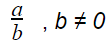 Therefore, practically every fraction that you have worked with in the past can be defined as a rational number. The only condition is that the “bottom” number in the fraction – also known as the denominator – cannot be equal to zero. Therefore, all whole numbers are rational, since any rational whole number can be expressed as a fraction with 1 in the denominator slot.

But how can you identify rational numbers from irrational numbers? Irrational numbers are not able to follow the rule that it can be presented as a over b, where b is not equal to zero.
In this case, you might come across irrational numbers that look like the following:
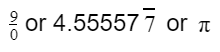
When looking at a fraction, sometimes the numerator can be zero. This means that a can equal zero, but b is not equal to zero. For new learners, just seeing a zero in the equation can sometimes throw off their thought process. However, keep in mind that a rational number with zero as a numerator can easily be simplified as such:
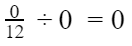
Since the greatest common denominator between 0 and 12 is 0, you can simplify a rational number fraction with a zero in the numerator by dividing both integers by zero. If you see a fraction with zero in the numerator, the answer will ALWAYS be zero.
Examples of rational numbers
Some examples of rational numbers include ¼, ⅔, 0/1, 8/6, and so on. As you can see, one of the numbers included here was 0 over another number – this is considered a rational number since the denominator is either a positive or negative number and is not equal to zero.
Operations on rational numbers
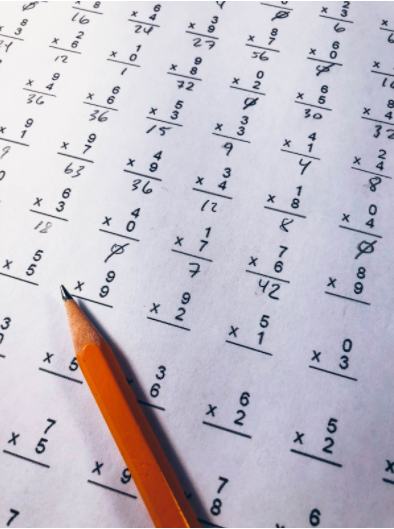
Just because a number is a fraction or contains a zero within the fraction, this does not mean arithmetic operations are impossible. Arithmetic operations are the basic processes of functions you can use with integers, including addition, subtraction, multiplication, and division.
- With addition, you can add two fractional rational numbers by making the denominator the same value.
- When carrying out subtraction, make the denominator the same number before subtracting one rational number from the other one.
- In the case of multiplying two rational numbers, make sure you multiply both the numerator and the denominator of the rational numbers.
- When it comes to dividing a fraction, you must calculate the inverse of the rational number. In this process, switch the numerator and denominator.
- For example, 2/4 will then switch to 4/2. You can double-check your work by multiplying the two values together to see if they equal 1, with the equation being (2/4)x(4/2)=1.
What are irrational numbers?
There are clear differences between rational and irrational numbers. Now that you know rational numbers are any type of integer that can be expressed as a/b where b does not equal zero, you can narrow down all integers that do not follow this formula to be considered irrational numbers.
Rational numbers are either positive numbers, negative numbers, or equivalent to zero. However, irrational numbers cannot be written in the form of a/b, but must be written as a decimal.
One of the most common irrational numbers is Pi (), which has endless digits after the decimal point. If you have studied geometry in the past, you know that Pi is the ratio of the circumference of a circle to its diameter – a number that comes out to approximately 3.14. However, this solution is just an approximation, but not accurate enough to be written as a fraction or classified as a rational number. Since the decimal digits of Pi are nearly infinite, you cannot use a simple fraction that represents Pi.
Furthermore, Euler’s number () is another irrational number that cannot be simplified or written as a fraction. This number is the base of natural logarithms and is an important concept used in the exponential function. Euler’s number is typically written as 2.718, but contains over 1 trillion digits in the decimal – making it impossible to compose in fractional form.
Another common irrational number is the Golden Ratio (), a ratio called “divine proportion”. This unique ratio is a common number that is found in various aspects of our life and culture, not just in mathematics. Appearing in paintings, artwork, sculptures, and buildings, the Golden Ratio is known for being aesthetically pleasing. This number is typically approximated as 1.618, but cannot be expressed in simple fraction form.
So – is zero a rational number?
Now that you know the difference between rational and irrational numbers, you may still be asking yourself – is zero a rational number? You know that zero cannot be the denominator of a rational number, since this would classify the rational function as undefined. However, zero can be the numerator in a fraction, which qualifies zero as an eligible rational number.
Since zero is an integer, it can be written as A in the formula A/B (ex: 0/1, 0/3, 0/6, etc.). Writing zero as the numerator over a positive or negative denominator confirms that zero can be considered a rational number (ex: 0/2, 0/-2, etc.).
Keep in mind that 0 cannot be used as a denominator in a rational number equation. If this was the case, any number divided by 0 would result in infinity – as we learned earlier, irrational numbers cannot be written as a fraction with integers as both the numerator and denominator. Any integer divided by 0 is an irrational number.
Why is it important to know if zero is a rational number?
If you are struggling in your math class and you have finally cracked the code to the rational vs. irrational number debate you might still be wondering how this will help you understand difficult math concepts.
Knowing that zero is a rational number can give you deeper insight as to how integers can be calculated and how they function within different equations. Being able to distinguish between rational and irrational numbers can help you understand more difficult concepts that you previously had a difficult time understanding.
Learning rational numbers, understanding how to interpret rational numbers, and identifying rational vs. irrational numbers can help students understand how to represent rational numbers when composing equations, how to determine which fractions are greater than others, and how to simplify rational numbers in fractional form.
July 23, 2021
How To Find A Statistics Tutor
“As with almost anything, you benefit most by being taught by someone who has a solid knowledge of the fundamentals, has real world experience in the area, and has the ability to communicate effectively.”
― Ron Glaser, P.H.D., retired US Government statistician and retired UC Davis Statistics Professor, on finding the right statistics tutor.
If you are looking for a statistics tutor, there is a good probability you are looking at a math syllabus full of unusual words: biostatistics, linear models, regression analysis, data mining, survey sampling—that kind of thing.
Statistics isn’t like algebra or geometry, it’s a whole other animal. Even calculus professors can be lousy when it comes to statistics. And if you need help, you may find your math tutor doesn’t make the best statistics teacher either. So, where do you find the elusive statistics pro? Craigslist? The local college career office? Is there a young, fun descendant of the Father of Modern Statistics Sir Ronald Aylmer Fisher living in Portland?
If you actively seek out a statistics specialist, there’s a ninety-nine percent chance you will find what you’re looking for. But if you want a 100% guarantee, here’s what you need to do…
Where to Find a Statistics Tutor
If you sense you need help in statistics, you are already ahead of the curve. Many struggling students can be too stubborn to get help and end up tanking their grade point average by attempting to take on statistics on their own. If they pursue a career that uses statistics, such as sales or computer programming, they might be at a loss, frantically searching the internet for a review course. But it doesn’t have to be that way!
It’s important for anyone seeking a career that involves statistics to find a statistics tutor with a well-rounded understanding of both statistical computations and how it relates to a career in data science or statistics. The best place to find private statistics tutors is online. Don’t be overwhelmed with all the tutoring websites out there because there are ways to trim the fat and find the perfect fit.
Look for websites that have been around for a while, have helpful contact information, and use official email addresses or phone lines (as opposed to tutors’ personal contact information, which can be a sign of inexperience as a business). Another trait of a trustworthy tutoring site is a review section where users can provide feedback on their tutoring experience. This way you can validate a good reputation within your local tutoring community.
What Qualifications Should Your Tutor Have?
According to Ron Glaser, a retired Lawrence Livermore Lab statistician and university statistics professor, it’s ideal to find a tutor who has a degree in math or statistics, or a college student with marked success in statistics coursework. Glaser would not recommend engineers or scientists who have not had formal statistics training as tutors, because they tend to bluff on knowing lessons students need, but don’t actually know themselves.
You will need someone who can prepare you for college-level coursework in statistics, which translates to someone who has at least a B.S. in statistics or a closely-related field, such as biostatistics, applied mathematics, or computer science. If you are searching on the Internet, think grad student. If a tutor is actively working toward a Masters or PhD in statistics, they will have the necessary experience to teach course material and apply it to everyday life.
However, having academic experience isn’t always enough. Consider finding someone who has experience applying statistics in the workforce or has experience teaching or tutoring. The combination of education and experience in the field will be your best bet for a statistics tutor.
To take the search one step further, here is a checklist for just some of the key elements we look for when hiring statistics tutors at Tutor Portland:
- Can this tutor explain tough concepts in five different ways?
- Can this tutor use metaphors that relate to the student’s life?
- Can this tutor adopt an active approach with in-depth discussions about statistics?
- Does this tutor embody integrity and virtue?
- Can this tutor effectively teach us, the Tutor Portland team, before we hire them?
How much does a good statistics tutor cost and how to ask?
Okay, so you found yourself a qualified tutor named Sir Ronald Aylmer Fisher Jr. and he’s fabulous, but you need to know how much he charges per hour. Here’s a statistic for you: The cost of living in Portland is 29 percent higher than the national average. On a college student’s salary of $21,000 per year, with a meal card from the folks, can you afford a tutor?
Here’s the rundown on the costs:
At Tutor Portland, for instance, we offer online and in-home tutoring backed by a Better Grades Guarantee for our Portland peeps with different budgets. Let’s say you need a statistics tutor for your coursework at Portland State University. We charge $96 per hour for our Silver Plan academic coaching or $384 monthly for one hour per week. Your hours never expire, rolling over to future months, and the more hours you book, the more discounts you receive.
If you decide to hire an independent tutor without such payment models, you should consider asking their rates upfront. The more education, work experience, and overall skills the tutor has, the higher the rates may be. And don’t be shy— after all, statistics tutors are used to talking numbers.
How to Get the Most out of a Tutoring Session
It’s all about your personal needs. So the key to maximize your time with a tutor is to study between sessions. By being observant (and hopefully excited) about how statistics play out in the news, in school, in work-life, and at home, you will be mastering the subject in a meaningful way. Then when you meet with your tutor to review the lessons, you can have a deeper understanding of the course material in less time.
Now that You’ve Aced Statistics …
If statistics clicks with your brain after a tutoring course, you may even choose it as a career. Among the industries that hire statisticians, the median wages range from $70,000 to more than $100,000 per year. Statisticians are in high demand, and according to Northeastern University, employment for mathematicians and statisticians is expected to grow 30 percent from 2018 to 2028.
Now that you found your tutor who is qualified, affordable, and can get you ahead in your statistics class, what’s next? Maybe another class! TutorPortland offers tutoring in test prep, science, Spanish, and English, so contact us if you’re looking for some extra help.
March 24, 2021
How Tutoring Can Help Students Master Math in the Era of Virtual Learning
If your kids are taking math online right now, I can see why you might be worried. It’s hard enough to hope for As in math classes when kids are attending school in person, but 2020 made everything more complicated.
Now that class is online, it’s even easier for kids to find themselves falling behind. Students are more distracted and less engaged. Class discussions are virtually nonexistent. Getting individual attention from a teacher seems harder than ever. How in the world are students supposed to master complicated math concepts in this environment?
While the online format isn’t ideal, tutoring can help! For kids who are missing that one-on-one interaction, a math tutor can bring them the connection they crave, now from the comfort of their home. Classes are now almost always recorded, giving tutors a way to glimpse course material and work through it with students. Virtual pod-based tutoring can help kids supplement the social aspect they might be yearning for. So if you worry about your kid grasping the math curriculum, don’t give up just yet. Here’s how tutors can make a difference…
Engaging Students
Many parents worry that Zoom is less engaging than in person math class. There’s definitely some truth to that–it’s hard for kids to get invested in the material when they’re just another black square in a sea full of turned-off cameras. It’s tempting for kids to start playing Minecraft or scroll through Instagram during a lecture as there’s no teacher in the room. Discussions aren’t as fluid or active and it’s hard for kids to make themselves known. In this virtual environment, students are not as involved in the subject at hand.
However, getting a great tutor can help solve this problem. No longer will your kid be an anonymous member of a huge Zoom class. Tutoring gives kids a personal, individualized approach to learning, even through the internet.
At Tutor Portland, we give one-on-one tutoring that’s totally focused on engaging the student. Our tutors build a strong rapport with students, ensuring that kids feel safe to express their frustrations and explain their own way of thinking about problems. Tutors check back with students each week and give them the positive encouragement they need to strive for growth. Even though kids have to learn through a screen, with this approach, we can keep kids excited and interested in the material.
That being said, even if students remain involved, they might not be able to be able to keep up. Math is cumulative, meaning if students miss one concept, they can easily get behind. Working through recorded lectures with a tutor might be able to change that…
Keeping Students From Falling Behind
Fast-paced math lectures are so common, it’s a wonder how kids can keep up at all. This has been a problem long before online learning. It’s a byproduct of our tendency to teach math with little to no discussion among students, let alone individual questions and feedback. Now that many lectures are virtual, students might have even less opportunity to slow down the class and inquire about a tricky concept.
Luckily, in this new online educational environment, lectures are almost always recorded. These recorded lectures are made available to students at any time. This means students can go back and rewatch whenever they need to in case they get stuck on homework. They can pause and rewind or go to a specific section when they may have overlooked a detail. Plus, if they want to review for a midterm or a final, they have every lecture laid out for them online. Instead of having one chance to get the teacher’s lecture, they can access it any time.
This is a great tool that tutors and kids can use together. Previously, if a kid struggled to comprehend an idea, tutors would have to guess how the teacher taught it to them. Now, tutors can see exactly how the concept was explained to the student, so the tutor can more deeply understand their student’s learning process. Students and tutors can go through recorded videos and take a new look at any material the student doesn’t quite understand.
Beyond having relationships with teachers and tutors, students also need to relate to each other and work together. But, how can tutoring help kids get that experience without in-person classes?
Incorporating the Social Aspect
Although socializing with others may seem extraneous to learning equations, having discussions with others about material really helps struggling math students. Studies show that students understand concepts better when they’re able to verbalize their thinking and have back-and-forth exchanges with other individuals.
However, online school makes it impossible for kids to talk about material as they walk the halls, and makes forming study groups a lot more challenging. This is especially true if your student is new to the class or doesn’t have a group of classmates to collaborate with.
Tutoring can help by not only connecting students with a great tutor, but a network of their peers as well. My brother and I had this social component in mind when we created Zoom Tutor, a website made specifically to help kids through the online educational landscape. On Zoom Tutor, not only is one-on-one tutoring offered, but pod-based tutoring with a group of students as well.
This means students are organized into small groups that meet each week to go over material. Although they may not be able to gather in person (yet), these regular sessions give kids the ability to meet and work with an entirely new group of peers. Instead of working through problem after problem alone, they can have a community to share their frustrations and victories. This can fundamentally transform students’ attitudes towards math. Instead of stale repetition, these peer groups help make math fun and social.
Get Your Kid Tutoring Today!
Even though learning math online may seem like an impossible challenge, tutoring can help students make the most of it. When Zoom leaves kids uninvested, good tutoring can help them engage with material again. Working through recorded lectures with tutors can guide kids towards success if they find themselves falling behind. Incorporating group work into the online tutoring format can help students have meaningful discussions that allow them to get a grasp on complicated math subjects..
So if you want to help your kid make the most of learning math online, you can sign up for your first free Tutor Portland session here, free of charge. You can also check out Zoom Tutor here! If we can give students access to a meaningful learning experience despite the tribulations of the online format, we can help kids come out of this challenging time on top, ready to achieve their goals.
December 15, 2020
The Ultimate Guide to Math Placement Tests
So your child has completed their college apps and they’ve started to narrow down their higher education choices. Whether they want to attend a junior college, attend school part-time, or are taking the plunge into a four-year university, their big decision will help shape their future. You’ll want to be sure that they’re as prepared as they can be.
Before they even step foot in a classroom, their skills will need to be tested. Math placement tests are a required examination prior to enrolling in specific classes. If they’re worried about what lies ahead for them when it comes to math placement tests and scheduling math classes, there’s no need to worry.
We have the ultimate guide right here for parents and students like you to better understand what math placement tests are all about.
What is a Math Placement Test?
A math placement test is designed to measure a student’s math skills and gauge the most appropriate math classes they should take for the upcoming semester. Before starting college or university, students must complete a math placement test at home. This happens after a student has been admitted to a school and is a normal part of the enrollment process.
There is no passing or failing a math placement test. The point of these exams is to see how competent the student is in the subject. They are more of an assessment of personal skills rather than an analysis of mastery. A math placement test is not a measure of intelligence, but a measurement of personal experience and how well a student demonstrates that experience.
After the test, the school will tailor a choice of math class to the student’s best strengths. If a student is a top scorer, they’ll be rightly placed in advanced classes that will properly challenge them. If they score lower on the math placement test, then they will be placed in less intense math courses.
What to Expect on a Math Placement Test
Although all schools require students to take a math placement test, there is no universal standard they adhere to. Each university or college will create their own tests that best measure math skills according to their own set of standards.
However, there will be some similarities across the board. Questions will be pulled from a wide variety of math topics such as algebra, geometry, trigonometry, and some precalculus and calculus, but the questions will not dive deeply into each subject. The range of questions will be wide, not deep.
The wide-range of questions about basic concepts is followed by longer word problems. These word problems focus on the application of concepts. Students will apply the previously mentioned concepts to help solve longer story problems. Further, the test will ask students to provide written analysis to test if they can fully understand and demonstrate mathematical concepts.
These tests usually do not have a time limit and are mostly multiple choice. The point of the exam is to measure skill, not speed. They’re usually administered online too, so there is no need to travel to a testing location. The tests are often completed from the comfort of a student’s own home.
What’s The Deal with High Placement Scores?
Preparing for math placement tests can save students and parents time and money down the road. If your university requires payment for classes by the unit, students can save money by testing out of classes that would otherwise be required for their degree.
By scoring well, students can bypass entry-level courses and qualify for more challenging (and more interesting!) math classes. By scoring poorly, the school may place students in lower intensity remedial courses and take time away from more enriching classes.
If a student plans to enter a field that is less math-intensive, they can bypass math classes altogether if they score high enough. By testing out of basic math classes, they free their schedule to take other classes that are more relevant to their field of study. This will save time and money as students will skip a few steps on their way to complete their degree.
How to Prepare for a Math Placement Test
Before taking a placement test, I encourage students to brush up on basic mathematical concepts. A math placement test will have questions about basic arithmetic such as addition, subtraction, multiplication, division, fractions, proportions, averages, decimals, and integers. It sounds like a lot, but it’s nothing students haven’t mastered before!
Here are our tips to maximize your studying habits!
However, it’s important not to put too much weight on the outcome of the test. There is a downside of over-preparing. If students prepare for the test in anticipation to score “well” or “ace” the exam, then they could be setting themselves up for a difficult situation. By studying for hours to ace the exam, students may earn placement in an advanced level math course they are not ready for. They might become overwhelmed by the higher level material because of their inflated placement score.
Remember, there is no passing or failing these placement tests, so over-preparing won’t always pay off. Ending up in a less intense math course might be the perfect situation for a student who isn’t as mathematically gifted as their peers.
Conversely, if a student enters the math placement test completely unprepared, then they could be placed in a math course that is far below their skill set. These students might get stuck paying for a class that is repetitive, boring, and ultimately a waste of their time because they did not demonstrate higher level math skills on the placement test.
Final Thoughts on Math Placement Tests
If a higher education institution accepts you or your child into their program and requires you to take math placement tests, look into hiring a tutor. When you hire a tutor to work one-on-one, you can focus on reviewing the areas that are the best use of your time. Meeting with a tutor to hone math skills could make a positive difference for your future in higher education.
Experts from Tutor Portland or Zoom Tutor can assist in tailoring a plan for you or your child. Having a tutor that understands how the math placement test works will make a huge difference in your educational experience. By fortifying math experience, you will be ready to take a math placement test and best serve your educational career.
September 12, 2020
The Mystery of Who Invented Calculus
Let’s say you were the creator of one of the world’s most useful and life-changing inventions, but someone else discovered that invention at the same time and wanted to claim the credit. Wouldn’t you be … I don’t know … furious?! Wouldn’t you fight tooth and nail to be recognized for coming up with the essential mathematics behind engineering, computer science, and economics? That’s exactly what happened between Sir Isaac Newton and Gottfried Leibniz over the claim of who invented calculus. The problem is, there’s still some major controversy over who really created it despite there being hard evidence of both their work. Maybe you can decide for yourself…
While today’s scandals circulate around notorious twitter feeds, Newton and Leibniz’s battle for recognition over who invented calculus rocked the entirety of Europe in the 17th century. England was so invested in the mathematician from their country that they stuck with Newton’s theory setting them back 100 years in mathematical progress. So does that mean Leibniz was the first inventor? Well it’s not actually that simple.
And up close, the debate gets ugly and personal. There are intimidation tactics, receipts, slander, cliques (looking at you British Royal Society), and lots of shade. This isn’t the stuff you’ll find in your textbooks, but it was enough to make two scientists go to war to prove their accomplishments. They knew that being named the inventor of calculus was too significant to be left in the dust, forgotten. If they fought hard enough for the title, they knew we’d be talking about them today.
Background
When you think about who invented calculus, you might imagine some pompous aristocrat in a powdered wig. But early traces of calculus-related math were actually initiated in the time of the toga, long before the 1600s.
Around 250 BC, Archimedes of Syracuse was the first person to conceptualize the tangent, which is a straight line that grazes a curve and an instrumental concept in today’s calculus. This concept was described in the Archimedes Palimpsest, a document that uses a variety of rudimentary concepts to solve problems now treated by modern calculus. This kind of math would later be used by both Newton and Leibniz.
Other Greek philosophers built off Archimedes’ work in calculus, and in 500 AD India, mathematicians wrestled with the same early concepts. The astronomer and mathematical theorist, Aryabhata, began using infinitesimals to study the rate of change. He was later succeeded by astronomer Vatasseri Parameshvara Nambudiri, who invented calculus fragments, like an early version of the mean value theorem [1] from the 15th century.
So, if calculus has been around for a while, why are Newton and Leibniz fighting over who gets all the royalties? Weren’t they just two links in a long chain of people who invented calculus before? Because it didn’t have the legs to stand on as an independent type of study before they put all the pieces together. In order to understand their contributions and why it’s important to know who invented calculus, you first need to know what calculus is in the first place.
Essentially, calculus is a branch of mathematics that quantifies how a thing changes. It’s kind of like how geometry examines the properties of shapes and how algebra is the study of arithmetic (numbers). More specifically, calculus uses infinitesimals, or an endlessly smaller measurement than real numbers, to describe the size of a change. So, the person who invented calculus would be recognized as a genius! This is what Newton and Leibniz were at war over.
Now, our mystery of who invented calculus takes place during The Scientific Revolution in Europe between 1543 – 1687. This was a time when developments in math, physics, astronomy, biology, anatomy, and chemistry dramatically changed how people thought about nature. Seriously, people began challenging archaic religious beliefs with scientific discovery about the center of the universe[2] and fundamental human rights. [3]
You can imagine how heartbreaking it must have felt for both Newton and Leibniz to get their names among the ranks of Galileo, Kepler, and Copernicus. They created a feasible means of doing math with numbers that didn’t totally exist yet! Not only were they fighting to protect their honor and pride in their work, but the chance to become an A-list celebrity. These guys were fighting over Oprah vs. Robert Downey Jr. levels of fame. Indeed, being the person who invented calculus is the kind of stuff that puts you in history books and is precisely what was at stake for both theorists.
Who are the Defendants?
Let’s start with the more well-known contender for who invented calculus. Sir Isaac Newton was born on December 25, 1642 (a Christmas baby!) in the United Kingdom and became a mathematician, physicist, astronomer, theologian, refusing to stay sequestered on his mother’s low-income farm.
Isaac is recognized for discovering gravity when he allegedly witnessed an apple falling while contemplating the literal forces of nature. He later realized that gravitational forces constantly exist between all objects and used this theory to explain that the Earth moves in relation to the Sun.
Newton also has many other accomplishments. He discovered ways to describe how thing’s move with force [4], how colors are actually made up of light, and he initiated groundbreaking studies on the speed of sound! Newton was also mentored by Isaac Barrow, one of the foremost thinkers of calculus-ish mathematics[5] during the European Enlightenment. It wouldn’t be that surprising if such an accomplished mathematician as Newton came up with this branch of the subject. Why not say he was the one who invented calculus as well and call it a day?
Because…
Gottfried Leibniz was also an ambitious scholar and a passionate thinker in his own right. Born on July 1st, 1646 to wealthy German parents, Leibniz inherited an impressive collection of advanced philosophy at the age of six when his Father passed away. Many of the works he read weren’t available to general school audiences, so he took an interest in the exclusive material because, well, it’s not like they had Youtube back then.
By the age of 18, Leibniz graduated with a Master of Philosophy and was awarded a Bachelor of Law after just one year of legal studies. He later developed the binary system,[6] invented modern formal logic, predicted problems later addressed by Albert Einstein, and daydreamt about computing systems that could do algebra. Leibniz’s accomplishments made him a valid response to the question of “who invented calculus.”
Leibniz even created his own theory of truth. Seriously, he thought he could explain the entire universe through simple logic statements. He was so famous, even before being considered as a potential mathematician who invented calculus, that the internationally renowned German chocolate covered biscuits were named Leibniz-Keks. Apparently that’s what happens when you’re the most notable person to reside in Hanover, where the manufacturer is located.
Now that you’ve got an idea of who Isaac Newton and Gottfried Leibniz are and what they’re capable of, it’s time to figure out who invented calculus and review the hard evidence.
The Evidence
Despite the controversy over who invented calculus, there is actually a well-documented record of each mathematician’s findings over the years. We’ll use this here to paint a picture of how things went down so you can really be the judge of who deserves the sole title of inventor.
1666
This is Newton’s annus mirabilis, the “miracle year” when he discovered gravity and started to theorize about colors. In 1666, Newton was sent home from Cambridge University after graduating due to the bubonic plague. With all this time on his hands, he initiated work on calculus, calling it then, “the method of fluxions.” Newton focused on geometry and the physical world in his work rather than theoretical concepts.
However, all of this thinking was off the books and in the early stages of development. Nothing had been published yet and his work largely remained in his personal collection or resided in letters to correspondents…
1674
Leibniz started working on his theory of calculus a few years before making a breakthrough in 1675. While he was in Paris on November 11th, 1675, he made a breakthrough, inventing a new system of notation. This breakthrough is important because it was unique from Newton’s methodology in that it approached calculus from a completely different side of math. Ultimately, it was more robust and practical.
1686
Leibniz published the Discourse on Metaphysics, his formal explanation of calculus in 1686. This book is significant because it means that Leibniz published his calculus work before Newton.
1687
A year after Leibniz’s publication, Newton published his findings in the Philosophiæ Naturalis Principia Mathematica. This is the big one, the publication that is praised as one of, if not, the greatest science book of all time. Despite some early problems in the work, Newton used this new calculus in his book to support the theories in his book.
The Principia Mathematica is where Newton presents his findings about gravity, motion, and planets, basically all the stuff that he’s famous for. It swiftly won him presidency of The Royal Society, the highest independent scientific academy from the United Kingdom that still operates today. Newton’s esteemed position as the head of the most influential scientific group garnered him a steep advantage over Leibniz in terms of cultural recognition.
The Rivalry
At first, Newton and Leibniz didn’t have an ugly conflict. They were both highly publicized members of the scientific community, so it was likely that they had seen each other’s work. But since Leibniz had published first, it was Leibniz not Newton who had sole credit for inventing this amazing new field of mathematics. The recognition Leibniz won for Discourse on Metaphysics, may have left Newton with the need to center his own accomplishments.
- Leibniz published work on calculus in Discourse on Metaphysics: 1686
- Newton’s published work on calculus in Principia Mathematica: 1687
Newton notably led The Royal Society through an aggressive agenda to publish the Commercium Epistolicum, a ledger containing letters from both Leibniz and Newton to correspondents about their work on calculus. The point of publishing this ledger was to publicize dated documents proving that Newton started working on calculus before Leibniz.
The two key pieces of evidence from the Commercium Epistolicum that Newton used to prove he was truly the one who invented calculus include: 1) Letters submitted to The Royal Society from Isaac Barrow, Newton’s mentor. These letters showed that Newton’s work in calculus began in 1666, and 2) Letters submitted to The Royal Society from Leibniz, explicitly expressing an early interest in calculus dated in 1673, clearly after Newton’s work began on the subject.
- Newton’s letters to Isaac Barrow about calculus: 1666
- Leibniz’s letters to The Royal Society expressing interest in calculus: 1673
But Newton wasn’t satisfied. Proving that he started working on calculus first wasn’t enough; he wanted to completely annihilate Leibniz’s credibility. After all, Leibniz’s method is superior to Newton’s, and Newton knew it. Newton also knew that this branch of mathematics was too important to become irrelevant in its history, so he embarked on a complete smear campaign to prove that Leibniz plagiarized.
It devolved into an all-out war to prove who invented calculus. Both Newton and Leibniz tried publishing several statements expanding on how each one’s math was superior to the other’s. But Newton had a huge advantage: he was the president of The Royal Society, and no one dared challenge the establishment.
The one notable scientist that stood up on Leibniz’s behalf was a mathematician named Johann Bernoulli. When Bernoulli publicly announced support for Leibniz’s credibility as the one who invented calculus, Newton swooped in with a silent brigade of intimidation tactics. Bernoulli eventually retracted his statements, and Leibniz was left alone, again, to fend for himself.
The finishing blow of Newton’s attack came in the form of a devious claim: Newton argued that because his letters were circulating around the scientific community at the time, Leibniz must have seen them and started copying off Newton’s invention. However, Leibniz’s methodology is dramatically different from Newton’s. More than anything, Newton’s evidence proves that both Newton and Leibniz independently discovered calculus using their own approaches to the work.
Conclusions
In the end, The Royal Society deemed their president the sole discoverer of calculus in 1715, using Newton’s name to proudly answer “who invented calculus” while Leibniz’s credibility dwindled until his death a year later. As a result of the UK’s nationalistic pride in Newton, they refused to use Leibniz’s superior method and suffered for it as the rest of Europe progressed without them.
Today, the scientific community recognizes both mathematicians for their work and respects that they individually made discoveries about calculus independently. Knowing who invented calculus is the kind of history that isn’t taught in textbooks, but it can make math more interesting when you learn where it came from.
Clearly, it’s important to engage in ideas beyond the text with peers, mentors, tutors, and teachers. You might even be able to bring up who invented calculus at a party as a secretly dramatic tale of scandal and sabotage.
Sources & Citations
[1] The mean value theorem is a type of formula that calculates the sine, or a specific angle’s dimensions.
[2] In 1543, Nicholaus Copernicus argued that the Sun was near the center of the Universe and that the Earth along with all the other planets orbited around it in circular paths.
[3] John Locke argued for the fundamental human rights of “life, liberty, and property” in An Essay Concerning Human Understanding in 1689.
[4] Newton’s Three Laws of Motion: 1. An object is equal to its mass times its acceleration, 2. The force of an object is equal to its mass times its acceleration, and 3. When two objects collide, they apply force to each other of equal magnitude and opposite direction
[5] Barrow pursued the concept of the derivative and linked calculus concepts like differentiation and integration.
[6] The binary number system serves as an alternative to the decimal system that is used in our day to day actions. Rather than using a 10-digit-based system, the binary number system uses 1’s and 0’s to simplify the design of technology. Essentially, it makes up the basis of all contemporary electronics and computers.
August 24, 2019
In-Home Math Tutoring
What is in-home math tutoring?
In-home math tutoring is one of the most common and popular types of tutoring for several reasons. In-home tutoring is incredibly popular because families love the convenience and lack of stress that comes with having a tutor come out directly to your home at a time of your choosing. Families have busy schedules these days! We get it. Everyone is packed full and overloaded. You simply don’t have time to drive all over town. That’s why in-home math tutors come to you! Another reason this type of tutoring is so popular is that math is one of the most difficult subjects for students to learn. Time and time again we see students struggling in courses such as geometry and algebra and trigonometry.
How does in-home math tutoring work?
In-home math tutoring is really pretty simple. The first step is scheduling your free session. That’s right, every first time Tutor Portland member gets access to a free tutoring session. You will have an initial phone call with our founder, Eric. In this quick free introductory call, we will cover all the details prior to the session. We will ask about your child and your learning goals. We will ask some initial discovery questions to assess where exactly your student is at, and what skills and tools will benefit them the most. Then we will pick a tutor who we believe to be the best match. And we will set a time for your initial free session. 99% of the time this first session is a good fit. And nearly everyone who receives the session signs up to become a paying member.
What is an in-home math tutoring membership?
An in-home math tutoring membership is something that we offer at Tutor Portland. Our memberships are designed to be incredibly customer-focused. Our mission is to be the most customer-focused company in the world. We believe in the customer. Our founder was tired of brands not treating customers right. He wanted his brand, Tutor Portland, to stand for something. And we chose to stand for the customer. That’s why our tutoring membership is flexible. You can cancel anytime. The sessions are yours to keep, they never expire. And the first session is always free. We also have a better grades guarantee. This means that for our top two membership tiers we guarantee that your child’s grades will improve.
We set up our membership this way because we realized that customers are the most important thing in the world. Your satisfaction means everything to us. The only reason that we are here in business is to serve you. Please consider letting us do just that.
Why learn mathematics?
There are countless reasons why it’s important to learn mathematics. Many students complain about learning math. They say: “when will I ever need to learn this?” I get it! I used to be one of those students. But there are so many jobs that require math. Here are just a few positions which are generally filled by mathematicians or which math majors are normally hired for:
- Accountant
- Biostatistician
- Computer Programmer
- Computer Systems Analyst
- Doctor
- Financial Analyst
- Financial Manager
- Information Systems Analyst
- Insurance Underwriter
- Inventory Control Specialist
- Investment Manager
- Market Research Analyst
- Professor
- Risk Manager
- Securities Analyst
- Statistician
These are some of the most common jobs you can get from learning math.
Two of the most common responses for why it’s important to learn math is because A) it can prepare you for STEM-related jobs and positions and B) because math is inherently beautiful. Some mathematicians have called these the classical reasons. These classical reasons are indeed very strong reasons to learn mathematics. But there are also other reasons why someone might want to learn mathematics. Learning mathematics can add to the diversity of your knowledge. Mathematics—especially ideas such as ratios, rate of change, and simple algebra concepts—can be used to think about our world in unique and compelling ways. Mathematics can make you a better person by giving you a mental framework to think about the philosophical problems of fairness and equity. In addition, learning mathematics will make you more rational and reasonable. It will help you see that most of life is statistics, it comes down to odds and chances.
What are Tutor Portland’s beliefs about math education?
Tutor Portland believes that mathematics tutors and teachers should take an active approach. Most students don’t do well at math because they aren’t interested and they are not engaged in the course. This is usually because the course is lecture-based and they fall behind in the course. However, small & active group work allows students to engage with others. Working with others allows students to attempt to put their mathematical thinking into coherent sentences. Normally, when doing this, students will begin to see the holes and gaps in their own learning and reasoning. They can then ask questions and try to dive deeper.
Therefore, at Tutor Portland, we take an active learning approach. We don’t believe in bland memorization of facts or rules. We want students to understand the rules. We want them to feel what a derivative is. To experience it. To know what it is before they are taught the formula. This type of learning is sticky. But it also takes more time to plan and more skill to execute. That is why most teachers stick to lectures and most tutors simply do low-level homework help. Creating a good active learning environment is really hard.
We also follow what is known as the peer-assisted learning approach. This approach is built upon research showing that students make the largest learning gains when they actively teach another individual how to complete or solve a problem. We, therefore, implement that into our tutoring. Once we have sufficiently taught a skill to one of our students through active learning strategies. We then employ peer-assisted strategies and have our students teach *us* the material. This does a number of things. First, it challenges the student because they have to become the teacher for a few minutes. Second, it shows us how much the student truly understands and where they might be falling short. And lastly, this strategy leads to the biggest learning gains.
What is active learning?
Most teachers and tutors believe that their learning environment is inherently an “active” one. But that is far from always being true. Active learning environments do not generally arise spontaneously or from chance. They need to be built, crafted, composed. Essentially, courses or tutoring sessions in which students only listen are the worst teaching methods possible. These lead to the lowest learning gains. Research shows that students need to think, discuss, write, and engage. They need to perform higher-level thinking: synthesis and analysis. Interestingly, students actually prefer to be more engaged—and they learn more when they are. That’s why we take an active learning approach with our in-home math tutoring.
August 22, 2019
Portland Math Tutors
What are Portland math tutors?
When your child starts to struggle in mathematics, complain, and bring home poor report card grades, the last thing in the world you want to have to focus on is re-learning mathematics and trying to teach them. Having the best Portland Math Tutors available at your door within hours can be a massive relief. Whether your child scored and B+ on a recent exam, or whether they have been struggling with and failing math all year long, Tutor Portland is there to cover for you and help your child start earning A’s again.
In a world that is increasingly being dominated by science and mathematics, the best thing your child can do is master those subjects, and we can help with that.
How do Portland math tutors work?
Math tutoring is simple with Tutor Portland. You pay a monthly membership fee in order to have access to a top hand-picked math tutor who comes out to your home for sessions at a time that is most convenient to you.
If your child is wanting help with homework, preparing for a quiz, or learning conceptual math problems, just give us a call and we can set up tutoring. With our monthly memberships, you can rest assured knowing that a math tutor is always available for you. Most families to choose to pick one tutor and stick with them. Together, they find a weekly time and meet every week to work on homework, higher-level thinking, and general study strategies.
You are only responsible for making sure your child is fed, ready, and prepared for the tutoring session. We will cover everything else! We know how challenging it is for parents and family members to try and tutor each other. We have heard countless stories about this not working out. That’s why many families choose to leave their tutoring up to us!
What topics do Portland math tutors cover?
Portland math tutors cover a variety of topics. This includes algebra, geometry, calculus, and other concepts and courses your child might be taking. We have different membership tiers, which allow you to focus on any of these subjects for a certain number of hours per week. We are proud to offer an unlimited membership, which means that you can do as many tutoring hours as you’d like or as many as you can schedule. With this, there are no limits to the amount of tutoring that we can do. There is also no limit to the concepts or topics we can cover.
What’s Covered:
- Arithmetic
- Pre-Algebra
- Algebra
- Functions
- Modeling
- Geometry
- Statistics
- Probability
- Pre-Calculus
- Calculus
- Trigonometry
How much do math tutors in Portland cost?
Hiring math tutors in Portland can range in price depending on your location, zip code, travel distance, subject, and more. Usually, tutors who teach more challenging subjects charge more than those who teach foundational material. Some organizations offer group tutoring. At Tutor Portland, we focus on individualized personal tutoring. We charge a monthly membership fee based on the number of sessions (hours) that you want to use per month. We believe this makes tutoring simply and more accessible because the rate is standardized regardless of where you live or what subject you need to learn. This allows you to efficiently budget for your children over the course of their academic career. To look up more information about our pricing, you can visit our membership page to see what each different membership tier costs.
When should I get math tutoring for my child?
This really depends on you, your situation, and your goals. We recommend math tutoring first and foremost if your child is struggling with math or if they don’t enjoy math. These two things often go hand-in-hand. People don’t like math because they are bad at it! Normally, once students start tutoring they get better at math and start to really enjoy it.
We also recommend tutoring for students who want to stay ahead of the curve. Many families today realize that college is getting more and more competitive. They are also discovering and reading about how the best careers often involve science, technology, and mathematics. Therefore, we’ve worked with many families that want to simply keep their kids ahead of the curve—and ensure that they are really mastering the material.
Some families even ask for tutoring for their kids who are very gifted at math. Often times they will ask for help preparing for an AP or IB examination. Other families have asked us to help prepare their kids for the SAT, SSAT, or ACT.
Why are math tutors important?
Math tutors are becoming more important for several reasons.
- With the increase in technology, students today are having trouble focusing. This is hindering their ability to learn mathematics. Some research has found that calculators and other technology are reducing children’s mathematical reasoning ability and conceptual understanding. Research has found that high-tech classrooms equipped with “interactive whiteboards” actually decrease a student’s math performance. In addition, mathematics learning software has been shown to have no benefit on student’s standardized test scores. One thing is clear: learning math the old fashioned way is what works. Learning math should be hard. It requires hours of sitting in front of a math textbook and working on it. Tutors can help explain some of these difficult ideas and get students working in the right direction.
- Colleges are getting more competitive. It takes higher math, science, and SAT scores to get into the top colleges these days. We can feel the rising stress among families even just since 2015 when we were started our local tutoring company. Acceptance rates are falling across the nation. Standardized test scores are inching higher and higher. Colleges such as Harvard reject students with perfect SAT scores year after year. Many students are now using the common application, which lets them hedge their bets and apply to more and more schools. In order to boost their children’s grades and mathematical understanding, many families are hiring tutors.
- All of the top students are working with tutors. This is causing the best students to pull further and further ahead from the pack. That’s one reason why it’s becoming more and more difficult for average good and great students to make it into great colleges. Top students are highly adept at mathematics. In addition to this, they are highly skilled in writing and English. This shows that they are well-rounded. This is why many parents are hiring subject tutors for various subjects.
What math courses do colleges expect you to have taken?
The majority of colleges expect students to have taken at least 3 years of math in high school. Many expect four years. At Tutor Portland, we highly highly highly recommend that students take four years of high school math. Colleges officially say that they don’t require it. But four years of math is largely accepted—and three years are often frowned upon by the admissions team.
Top schools also expect advanced courses such as Honors, IB, or AP mathematics. For students who want to become doctors or pursue other STEM degrees or programs in college, it is highly recommended that these students complete 4 years of advanced high school math with excellent marks in those courses. This will help set your child apart.
There are three different AP math courses offered to high school students: AP Calculus AB, AP Calculus BC, and AP Statistics. You can learn more about AP Exams and how they are graded here.
However, across the board, geometry and algebra are the bare minimum courses that need to be completed in order to graduate from high school. The vast majority of states have adopted the common core curriculum and standards, which were discussed earlier in this article.
Most high schools follow this progression of courses:
- Algebra 1
- Geometry
- Algebra 2/Trigonometry
- Pre-Calculus
- Calculus
Many students will commonly stop at pre-calculus. And this order is not the same at every school. There are some schools in Portland that teach geometry first and then algebra 1 and 2 following that.
Many students believe they will never need to use mathematics, so why bother studying it? And, at first glance, that appears to be true for people studying the humanities. Why do English majors need to know algebra? But these days colleges are realizing the value of having strong interdisciplinary students on their campuses.
Why should I choose Tutor Portland?
Tutor Portland is a local tutoring company that time and time again has gotten results for students. We take our clients very seriously and want to ensure that they have an incredible experience with us. And we will do whatever it takes to make that happen!
What makes Tutor Portland unique is our focus on active tutoring. We believe in having engaging tutoring sessions. Learning should be dynamic. That’s why we focus on active learning strategies which are based on research and have been proven to drive learning results. There is a lot of recent research on math and science education. The data clearly shows that students learn mathematics when they attempt to verbalize their mathematical reasoning and thinking. This helps them realize what they know, think through challenging concepts, and fill in gaps in their own mental models. That’s why we take an active approach. We ask questions which get students thinking and which nudge them to explain their mathematical reasoning.